
Choosing the right system to control entry across your facility is no longer a simple decision. As businesses grow and operations become more complex, access control needs to go beyond basic door entry. This is where the discussion around biometric access control systems and traditional keycard solutions becomes relevant.
At a high level, the difference comes down to how identity is verified. Keycard systems rely on something a user carries, while biometric systems rely on something a user is. That distinction has a direct impact on security, usability, and long-term system performance.
This article breaks down that difference in practical terms. Instead of focusing only on features, it looks at how each system performs in real environments, how they scale, and how they integrate into broader security infrastructure.
Understanding this access control comparison is not about choosing the most advanced technology. It is about selecting a system that aligns with how your facility operates, how your teams move, and how your security requirements evolve over time.
Understanding How Keycard Entry Systems Work
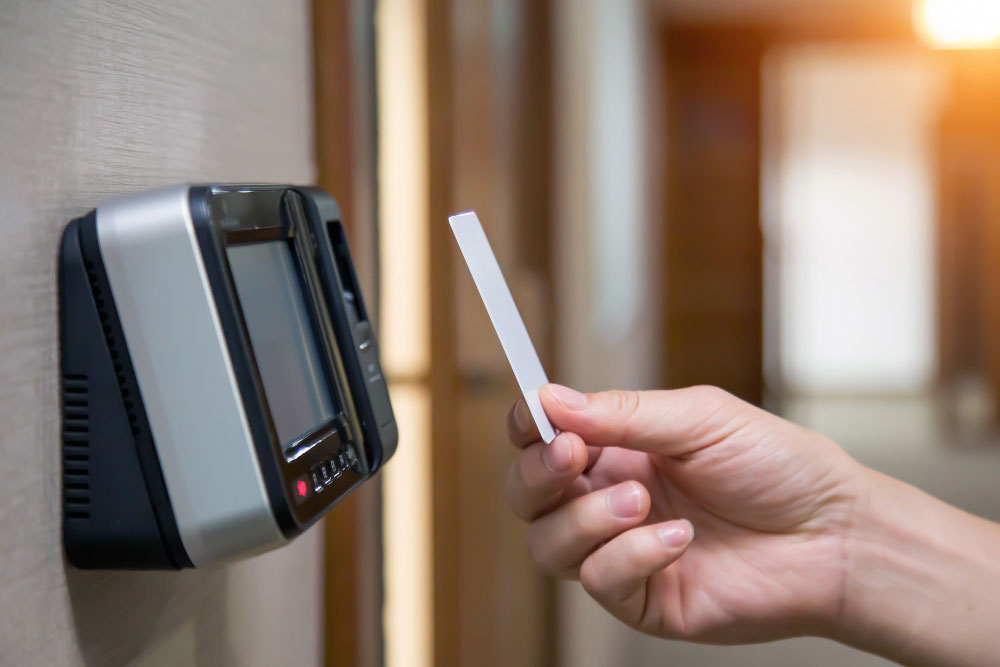
Keycard entry systems have been widely used across commercial properties for decades. They rely on physical credentials such as RFID cards, proximity badges, or smart cards. When a user presents the card to a reader, the system verifies permissions and grants access.
These systems are simple to deploy and easy to manage. New users can be added quickly by issuing a card and assigning access levels. This makes them suitable for environments where workforce changes are frequent.
One of the main strengths of keycard systems is flexibility. Access permissions can be adjusted without replacing hardware, and cards can be reprogrammed as roles change. This allows businesses to manage entry across multiple areas without complexity.
However, keycards introduce a dependency on physical credentials. Cards can be lost, shared, or copied. If a lost card is not reported immediately, unauthorized access may go unnoticed.
For facilities that require efficient entry across large teams, keycard systems remain a practical option. Their effectiveness depends on how well credentials are managed and how quickly issues such as lost cards are addressed.
What Biometric Access Control Systems Actually Do
Biometric systems take a different approach by verifying identity through physical characteristics. Instead of using a card, users authenticate using fingerprints, facial recognition, or other biometric data.
This removes the need for physical credentials. Access is tied directly to the individual, which reduces the risk of unauthorized entry through shared or stolen credentials.
Biometric systems are commonly used in environments where identity certainty matters. Facilities such as data centers, healthcare institutions, and restricted operational zones often rely on biometrics to control access.
The advantage is clear. Since biometric traits cannot be easily duplicated or transferred, the system maintains tighter control over who enters specific areas.
However, implementation requires planning. Factors such as lighting conditions, user interaction, and system calibration can affect performance. For example, fingerprint scanners may struggle in environments where hands are dirty or worn.
Biometric systems work best when they are aligned with the environment in which they are deployed. When configured correctly, they provide a higher level of control without relying on physical tokens.
Security Differences That Matter in Real Environments
Security is often the first factor considered in this decision, but it needs to be evaluated in practical terms rather than assumptions.
Keycard systems offer controlled access, but they rely on user behavior. If a card is lost, shared, or cloned, the system cannot distinguish between authorized and unauthorized use. This creates gaps that may not be visible immediately.
Biometric systems reduce this risk by linking access directly to identity. This eliminates common issues such as credential sharing and unauthorized duplication. It also improves accountability, as each access event is tied to a specific individual.
However, security is not only about technology. It also depends on how systems are implemented and maintained. Poor configuration or lack of integration can reduce effectiveness regardless of the system type.
For many businesses, the decision is not about choosing one over the other. It is about determining where higher identity verification is required and where flexibility is more important.
Cost Considerations Beyond Initial Investment
Cost is often viewed in terms of upfront investment, but this does not reflect the full picture.
Keycard systems have lower initial costs. Cards and readers are relatively affordable, and expanding the system is straightforward. However, ongoing costs include card replacements, administrative management, and potential security risks from lost credentials.
Biometric systems require higher upfront investment due to specialized hardware and software. However, they reduce ongoing expenses related to credential management. There are no cards to replace, and administrative overhead is lower.
When evaluating cost, it is important to consider long-term operational impact. For example, in environments with high employee turnover, managing physical credentials can become a recurring expense.
The decision should be based on the total system lifecycle rather than initial pricing. This includes installation, maintenance, and how the system performs over time.
User Experience and Day-to-Day Operations
Access control systems are used daily, which makes usability an important factor.
Keycard systems are familiar and require minimal training. Users simply tap or swipe their card to gain access. However, they depend on users remembering to carry their credentials.
Biometric systems remove that dependency. Users do not need to carry anything, which simplifies access. This can improve workflow, especially in environments where employees move frequently between areas.
At the same time, biometric systems require consistent conditions for accurate recognition. Environmental factors such as lighting or physical conditions can affect performance.
The choice between these systems should consider how users interact with the environment. A system that disrupts workflow can create delays, even if it offers stronger security.
Scalability and System Growth
As businesses expand, access control systems need to scale without major changes.
Keycard systems are easier to expand in the short term. Adding new users involves issuing additional cards, and adding new entry points is relatively straightforward.
Biometric systems can also scale, but they require more planning. Expanding the system may involve additional infrastructure, storage, and configuration.
Scalability is not just about adding users. It also includes integrating with other systems and maintaining performance across multiple locations.
For growing businesses, the ability to scale without disrupting operations is an important consideration. The system should align with future requirements, not just current needs.
Integration with Modern Security Systems
Access control does not operate in isolation. It works best when integrated with other technologies.
For example, combining access control with AI video surveillance systems allows businesses to link entry events with visual verification. This creates a clearer understanding of activity across the property.
Integration with smart security cameras also improves visibility. When an access event occurs, associated video footage can be reviewed instantly.
This level of integration transforms access control from a standalone system into part of a connected security environment.
It also supports AI security monitoring, where systems can detect unusual patterns and trigger alerts automatically.
The value of access control increases when it is part of a larger system that includes surveillance, monitoring, and analytics.
Where System Design and Installation Make the Difference
The effectiveness of any access control system depends on how it is implemented.
Proper access control installation involves more than placing readers and issuing credentials. It requires understanding how people move through the space, identifying high-risk areas, and configuring the system accordingly.
Poor design can lead to bottlenecks, gaps in coverage, and reduced system performance. This affects both security and daily operations.
Working with experienced providers helps align system design with real-world usage. This includes integrating commercial access control solutions with existing infrastructure and planning for future expansion.
Start with a System That Fits How Your Business Operates
At Insyte Security, we don’t take a one-size-fits-all approach. We evaluate your facility, workflows, and risk areas to design an access control system that actually works day to day. From keycard entry to biometric solutions and full system integration, everything is built for long-term performance.
If you’re planning a new system or upgrading an existing one, schedule a free security assessment with Insyte Security and get a solution tailored to your environment.